Tybee Island Ghosts…
A Little History
… First, it’s important to understand that originally, the Charter of the State of Georgia contained a provision that prohibited the importation of slaves into the new colony. Georgia was to be home to a free (and sober) working class, much like the Yeomen’s class in England, where merchants and craftsmen combined with small farmers to make up the economies of small communities.

The founding philosophy was that slave ownership promoted laziness, and a privileged landed gentry. Many of the new Georgia transplants were indentured servants, whose debts had been forgiven back in England. These ‘reformed’ individuals were being given a second chance on the frontier of the Crown’s youngest colony. They were encouraged to value ‘thriftiness and hard work,’ instead of excesses and indulgences. Thus, the Crown did not issue large land grants, as they had years before to the plantation owners of South Carolina. Instead, they appointed Trustees in Savannah as overseers of the common good.
Georgia’s first colonial settlers got forty acres to farm, and merchants and craftsmen were to set up shops in which to trade local goods and services. A portion of all proceeds and profits would go back to England through the Trustees. It sounded like a good plan, at first.
But low country coastal marshes were difficult to farm, and often populated by native Americans, not to mention the subtropical climate was infested with fever-bearing mosquitoes. (South Carolina had dealt with such obstacles and opted to employ slave labor.)
Soon, neither the farmers nor the merchants could make ends meet. Settlers began leaving the new ‘buffer colony’ in droves. The noble experiment envisioned by Oglethorpe and the Trustees was fast becoming a miserable failure. In order to save the colony, the Crown began issuing large land grants to wealthier colonists, but the larger farms could not operate without a substantial, affordable labor force.
In 1749, increasing social, economic, and political pressure forced Georgia’s founding fathers to repeal the anti-slavery provisions in their Colonial Charter. When the act that permitted the importation of slaves was issued, it contained a provision to establish quarantines to combat the risks associated with the influx of imported slaves, as well as the usual threats caused by illnesses from all incoming merchant ships. This reversal of social and commercial policy saved the colony’s economy, but eventually opened up a world of woe.
The quarantine at Lazaretto Creek, however, wasn’t built until 1768, almost twenty years later, on a hundred and four acres of land that had been purchased from Josiah Tattnall the year before. The buildings that housed the sick were constructed on the western tip of the island, at the mouth of South Channel Sound.
Although it served as a ‘hospital’ for less than two decades, it saw scores of unfortunate ‘detainees’ each year due to the span of time in which it operated. Throughout the years of the expanding slave trade, and during the days of the American Revolution, Tybee’s ‘lazaretto’ operated continuously as a holding station for the sick and the dying, until it was found to be completely uninhabitable in 1785. A new quarantine was constructed on nearby Cockspur Island to replace it.
In the days before public sanitation, immunizations and antibiotics, it was often necessary to employ drastic means to keep imported infections from spreading to the mainland. Anyone who became ill during the voyage to Georgia was subject to quarantine. Whether they traveled of their own accord, seeking freedom or fortune in the new world, or had been transported in chains, lying side by side with hundreds of captive slaves bound for market in Savannah, any individuals infected with a contagious disease like cholera, yellow fever or smallpox were either sent to the quarantine, or the ship on which they sailed would itself be detained in the channel. Sometimes the sick were put in small boats and rowed to the hammocks on Tybee. Sometimes they were tossed overboard to swim.
Once quarantined, these individuals stayed for a certain duration of time, where they either recovered, or died. Accounts vary as to whether it was for a month or four months. A worst-case scenario might be that they didn’t die immediately, or didn’t recover before the ship’s quarantine was lifted, and had to be transported to shore, where they might become infected with something worse, and end up staying, indefinitely.
The present-day Italian term ‘lazaretto, or lazaret’ simply translated means hospital, but in the Middle Ages it literally meant ‘pest house,’ and could actually describe any structure or vessel used as a holding station for people with contagious diseases, or a place for those dying from the plague or from leprosy. Derived from the Hebrew word ‘lazar or leper,’ it also refers to the biblical figure, “Lazarus,” the one whom Christ raised from the dead.
It was not uncommon for creeping ‘killer’ diseases to lurk in such places, and research indicates that remote portions of Tybee’s first quarantine also served as a leper’s colony. No doubt, Lazaretto was a desolate place.
Today, the western hammocks of Tybee Island are the picture of tranquility at the edge of the largest expanse of salt marsh on the entire southeastern coast. Whatever past scourges or secrets they possess, they bear them in total serenity, and the sunsets are magnificent.
Lazaretto Creek Marina; Memories; Ghosts
Captain Mike Scarbrough and his wife, Iris, first moved to Tybee in 1992, hoping to build a future with their young daughter, Lisa. They bought their property out at the Lazaretto Creek Marina from W.G. Smith, a local resident and fisherman who owns and operates the vessel known as the Agnes Marie, with his partner J. B. Griffle. The premises needed so much work that Iris says her initial response was just to jump in the car and head back to Atlanta. She recalls turning to Mike, and cringing, “Are you sure we really want to do this?”
The Scarbroughs worked a year or so restoring the docks and the old buildings at the marina while living on their boat, and eventually, converted a small house near the water into a bar with an office. They called it Mike’s Place. According to Iris it wasn’t much to look at, in fact, she says it was ‘a dump’ — if they had five customers on the weekends, they thought they’d been ‘discovered.’ Mike’s Place only served sandwiches, prepackaged snacks, and beer, but the fishing crowd at the docks always appreciated the little bar, and the regulars were friendly. The Scarbroughs continued to reclaim the grounds, and started a dolphin tour business, and over the course of the next decade, things really began to shape up. A seafood market also opened in another one of the buildings.
The fact that Lazaretto Creek had a few skeletons in its closet was never an issue. However, both Mike and Iris are quick to mention that several strange things happened during the first years they lived on the property.
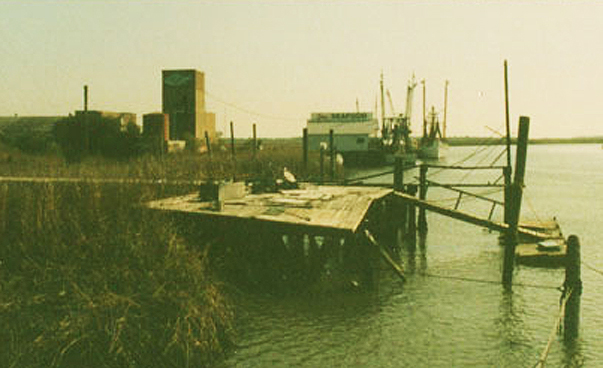
There are two incidences in particular. The first took place one night around three in the morning, when Mike happened to look out a back window of the house toward the creek. He thought he saw someone walking around on the dock — maybe, a couple of people. No one was supposed to be out there that time of night, so Mike went to investigate.
He headed down the plank walkway, ready for a confrontation, only to discover that no one was there. No one was anywhere around. Mike said he stood listening for a few moments to see if he could hear anything, but all was quiet, and there was no sign that any boat had left the dock. “For the life of me,” he says. “I couldn’t figure out where they might have gone.”
The second incident happened some time later when the Scarbrough’s daughter, Lisa, was in high school, and had a friend over from Savannah. They were sleeping in Lisa’s bedroom about three o’clock in the morning, when the friend was awakened with a start.
Glancing around, she said she saw a tall, wide-eyed black man in a tattered shirt, standing in the doorway of the room. She immediately shook Lisa, and the two of them woke Mike and Iris with their screams. The lights came on, but a thorough search turned up nothing. Though it was the last time the stranger was seen inside the house, Mike had to stand vigil for a while so his daughter could get to sleep at night.
In 1995, the marina hosted the U.S. and International Team trials, and in 1996, the yachting events of the Summer Olympics were held there, but it was when Mike took a group from Good Morning America out on the S.S. Dolphin for a tour, that his Dolphin Adventure Tours really took off. Captain Mike and First Mate, Iris, decided it was time to let someone else take over their eatery at the marina.
Joel Solomon moved in at Mike’s Place, renamed it “Cafe Loco,” and added live music on the weekends. Working late hours, after the musicians and the employees left, Joel would soon have his own encounter with the Scarbrough’s eerie night visitor.
Alone in the bar after closing one night, Joel was cleaning behind the counter when he heard a noise and looked up to see a man whom he didn’t recognize standing just inside the entryway — an African American man, wearing strangely tattered clothes. He didn’t come into the bar, but stood there for a moment like he was lost. Joel told him he was closed, and was about to ask if he needed help, when the man turned and slowly began walking as if he were going to take a seat in one of the booths. Joel left the counter to make sure his message was clear, but when he got to the front room, it was empty. The main door which had been secured earlier was still locked. According to Captain Mike, the incident was enough to prompt Joel to search the premises up and down before leaving that night.
There’s been some speculation throughout the years about the whereabouts of the mass grave sites associated with the quarantine. It’s generally believed the old buildings stood in a fairly protected area, near the river channel under the trees. If there were unmarked graves toward the marsh itself, most likely they were washed away by the tides throughout the years. It’s also quite possible that some graves were located where the new bridge now stands, and were unearthed when it was constructed. At the time, bones were reportedly discovered in that location, bobbing up from the ooze.
The Scarbroughs say a group from England showed up a few years back, looking for the unmarked grave of a British soldier whom they believed was buried somewhere on the grounds. Members of the group searched diligently, but it was in vain. Fact is, no remains have ever been located in or around the present-day grounds of Tybee Marina or the adjacent hammock. Considering there was over a hundred acres in the original tract bought from Josiah Tattnall in 1767 — a lot of ground to cover — most locals are doubtful that future searches will turn up anything, other than more speculation.
The ‘ghost’ that paid the three a.m. visits to the Scarbroughs and Joel Solomon hasn’t been seen lately. Iris says it’s probably because of all the ‘live’ activity on the premises at night. Captain Mike’s Dolphin Adventure Tours celebrated twenty years on Tybee in 2012, and these days the little village on Lazaretto Creek near the Tybee Island Marina is flooded with fishing and water sports enthusiasts, tourists and sight seers. Solomon sold Cafe Loco several years ago. Haven’t checked with the new owners of the place, now called Coco’s Sunset Grille, to find out if they’ve encountered anything. Maybe, there are just too many people around these days for a ‘lost soul’ to feel comfortable.
Maybe…
RIP.
* * * * * *
*Copyright 2012- 2023, Real Spooks – Cynthia Farr Kinkel
(*Portions of the above story appeared in the 12/2005 and 01/2006 issues of The Tybee Breeze, published in 2 parts as “Ghosts on Tybee – Song for Lazaretto.” Story appears in its entirety here.)




 Real Spooks